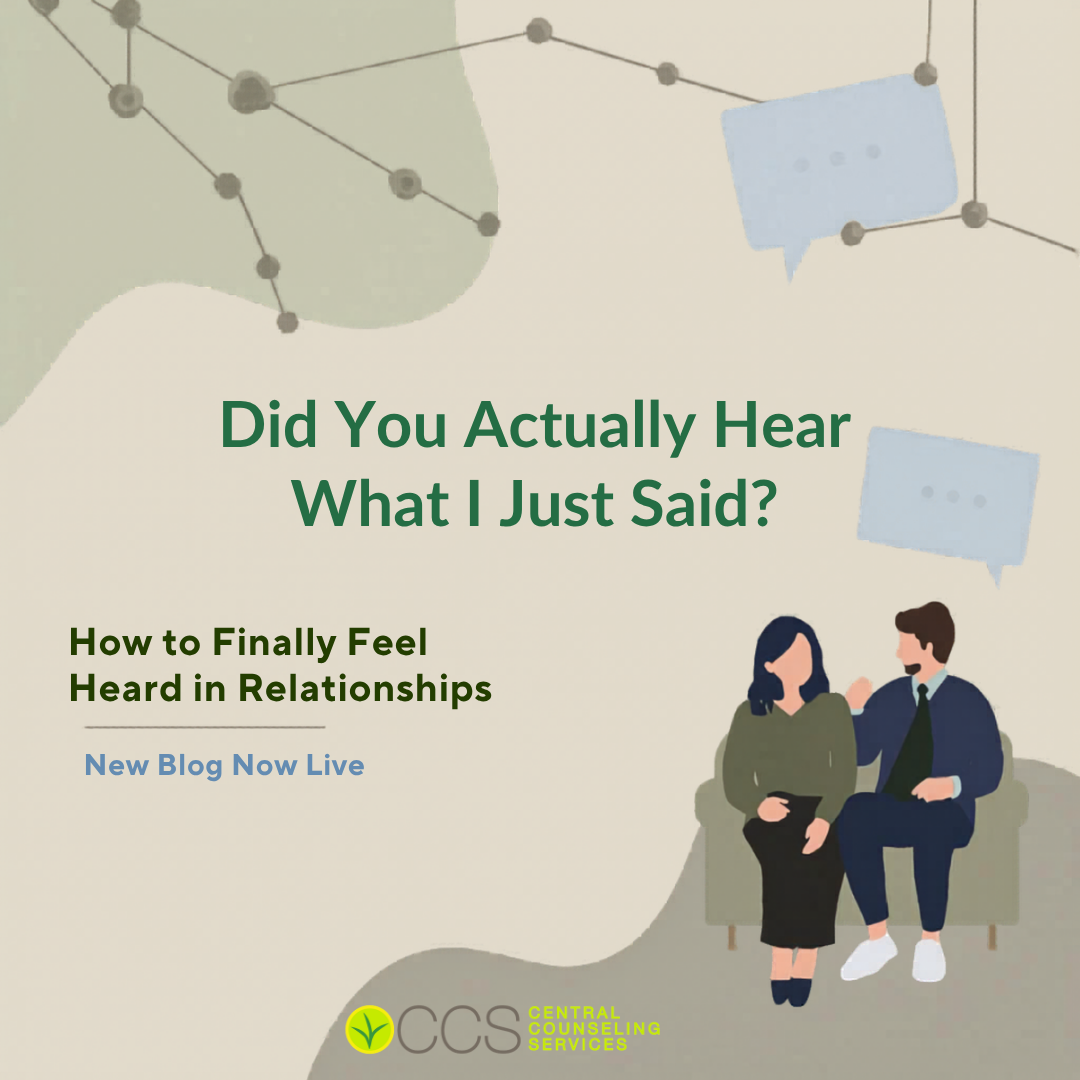
Did You Actually Hear What I Just Said? A Therapist’s Guide to Finally Feeling Heard
By Rose Cabral, AMFT | Central Counseling Services
Have you ever been talking directly to your partner — making eye contact, choosing your words carefully, trying your best to explain yourself — and somehow they still miss what you meant?
Maybe you’ve thought:
“How did that not land?”
”Are you even listening?”
”Why do I keep repeating myself?”
If so, you are far from alone.
Miscommunication is one of the most common challenges in close relationships. Research shows misunderstandings happen frequently even between people who genuinely care about each other and want to work together (Paxton et al., 2021).
Miscommunication is not a sign your relationship is doomed.
It is a human experience.
The good news is that communication skills can be learned, practiced, and improved.
Why Feeling Heard Matters
Being heard is about more than words.
It is about feeling understood, respected, emotionally safe, and important to the person you love.
When people consistently feel unheard, resentment often grows. Conversations become repetitive. Defensiveness increases. Small issues start feeling much bigger than they are.
But when both people feel understood, conflict becomes easier to navigate, and connection becomes easier to maintain.
1. Practice Active Listening — Really Listening
Many people listen while mentally preparing their response.
That is not the same as listening.
Active listening means your primary goal is to understand before being understood.
Try this:
• Maintain eye contact
• Put distractions away
• Listen without interrupting
• Reflect back what you heard
• Ask if you understood correctly
For example:
“What I’m hearing is that you felt alone when I dismissed that conversation. Is that right?”
The goal is not agreement.
The goal is an accurate understanding.
2. Remember: Your Body Is Talking Too
Communication is not only verbal.
Tone, posture, facial expressions, eye contact, and attention all communicate messages before words are processed.
You can say “I’m listening” while your body says something very different.
Helpful shifts include:
Uncrossing arms
Facing each other so you can see facial expressions
Putting phones away
Softening tone
Sitting beside each other rather than in opposition
Even subtle physical cues can make conversations feel safer and more productive.
3. Use Words That Open Doors
Some phrases escalate conflict immediately.
Others create space.
Consider these shifts:
Instead of:
“You never listen.”
Try:
“I feel unheard when I’m interrupted.”
Instead of:
“You always do this.”
Try:
“I’m feeling frustrated and want to talk about what happened today.”
Instead of mind-reading:
“If you cared, you’d know.”
Try:
“What I need right now is…”
Clear requests often work better than assumptions.
4. Stay With the Present Issue
One of the fastest ways conversations derail is by bringing in every past hurt at once.
When old grievances flood the room, resolution becomes nearly impossible.
Try staying with:
What happened today
How it affected you
What needs repair now
What would help moving forward
This keeps the conversation manageable and actionable.
5. Connection Matters More Than Winning
Many couples accidentally turn conflict into a courtroom.
Who is right?
Who remembers correctly?
Who started it?
But healthy relationships usually improve when the focus shifts from winning to understanding.
You can be technically right and still emotionally disconnected. The stronger goal is repair.
Why These Skills Matter Long-Term
Healthy communication does more than reduce arguments.
It builds trust.
It helps children witness respectful conflict resolution.
It creates resilience during stressful seasons.
It turns everyday tension into something manageable rather than catastrophic.
These skills compound over time.
When It Feels Too Hard Alone
Sometimes patterns are deeply rooted.
Maybe one partner shuts down. Another pursues harder. Old wounds get triggered quickly. Conversations spiral before either person understands why.
That is where therapy can help.
Couples therapy offers a structured space to slow conversations down, identify patterns, and learn healthier ways to communicate.
You do not have to wait for a crisis.
You Do Not Have to Figure This Out Alone
At Central Counseling Services, we help individuals and couples build communication skills that create safer, stronger relationships.
Whether you are navigating recurring conflict or simply want to feel more connected, support is available.
📞 Call us: 951-778-0230
🌐 Visit: CentralCounselingServices.net
About the Author
Rose Cabral, AMFT is an Associate Marriage and Family Therapist at Central Counseling Services. Rose brings both professional training and lived experience to her work, supporting clients moving from shame and hopelessness toward healing and empowerment.
Her approach draws from Cognitive Behavioral Therapy (CBT), Attachment Theory, Family Systems Theory, and trauma-informed care. Rose is collaborative, strengths-based, and deeply committed to helping clients build healthier relationships with themselves and others.
References
Paxton, A., Roche, J. M., Ibarra, A., & Tannenhaus, M. K. (2021). Predictions of miscommunication in verbal communication during collaborative joint action. Journal of Speech, Language, and Hearing Research.
Miller, L., Rozin, P., & Fiske, A. P. (1998). Food sharing and feeding another person suggest intimacy. European Journal of Social Psychology.