
Why Am I Still Awake? Bedtime Procrastination and the Battle for “Me Time”
You’re exhausted.
You’ve been saying you’re going to bed for the last hour.
Your alarm is already judging you from across the room.
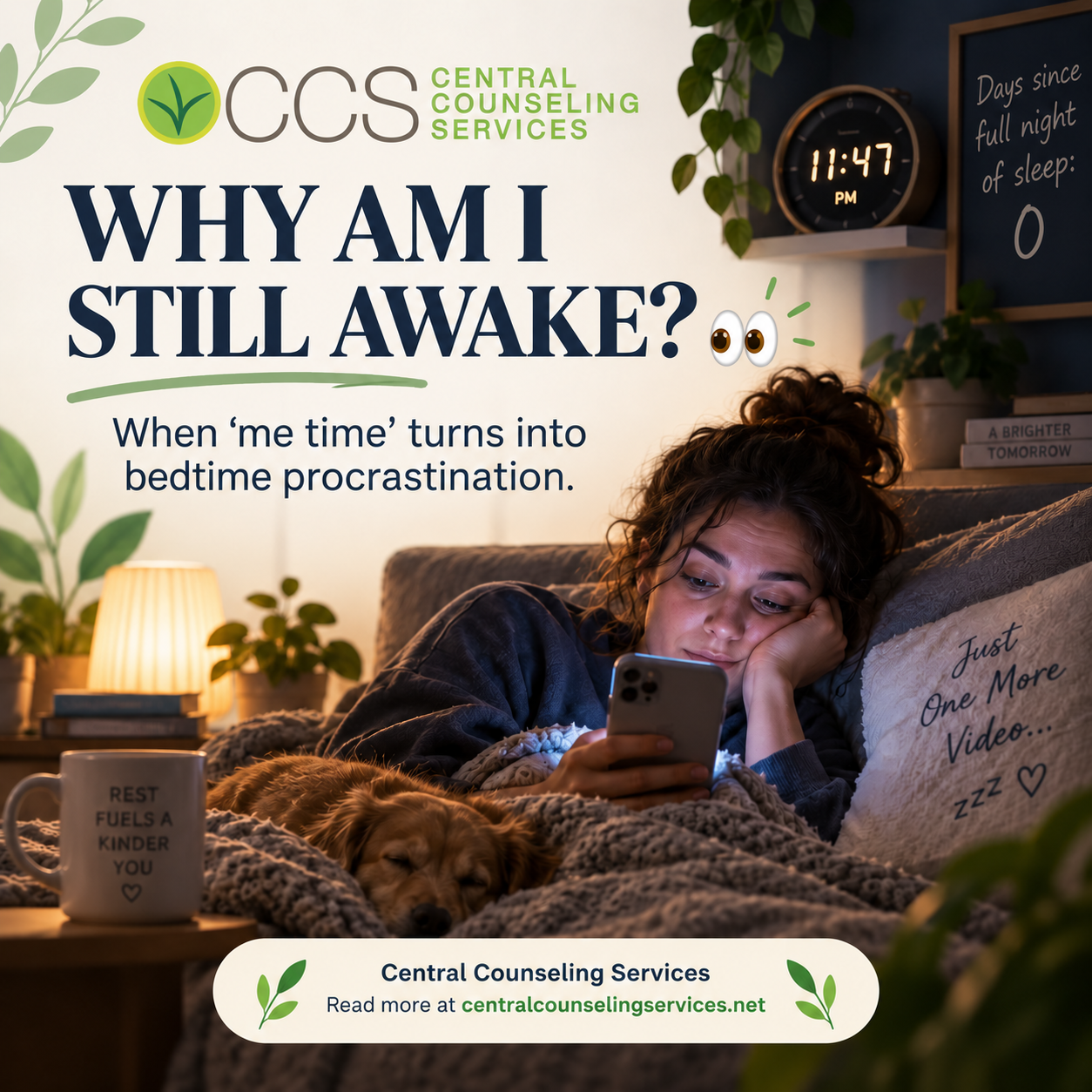
And yet somehow you’re still on the couch watching one more episode, scrolling through videos, reorganizing your online shopping cart, or suddenly deciding that 1:30 AM is the perfect time to learn everything there is to know about a topic you have never cared about before.
Sound familiar?
There’s actually a name for this: bedtime procrastination.
Bedtime procrastination happens when we delay going to bed even though there isn’t anything preventing us from doing so and we know we’ll probably regret it in the morning. Researchers have found that bedtime procrastination is associated with getting less sleep, poorer-quality sleep, and feeling more tired during the day.
But knowing we need sleep and actually going to sleep are apparently two very different things.
Why Do We Do This to Ourselves?
For some people, nighttime is the first moment all day that truly feels like their own.
Maybe the day was filled with work, parenting, caregiving, school, appointments, chores, emails, errands, and people needing something from you.
Then the house gets quiet.
Nobody is asking questions.
Nobody needs an answer.
Nobody needs you to remember where their shoes are.
And suddenly you have something you may not have had all day:
control over your own time.
Going to bed can feel strangely like giving that time back.
So we stretch the evening just a little longer.
And then a little longer.
And then suddenly it’s 1:06 AM, and tomorrow you have been completely betrayed.
It Isn’t Necessarily About Being “Bad at Sleep”
It can be tempting to frame bedtime procrastination as laziness or a lack of discipline, but the picture is more complicated.
A large research review found that bedtime procrastination is related to factors such as self-regulation and whether someone naturally tends to function later in the evening. The researchers also noted that more research is still needed before we can say exactly what causes the behavior.
Stress may matter too.
A 2026 systematic review and meta-analysis involving university students found that greater bedtime procrastination was associated with higher levels of perceived stress, anxiety, depressive symptoms, and overall psychological distress. That does not mean staying up late causes those problems, but it does suggest that sleep habits and emotional well-being can become tangled together.
Sometimes staying awake may simply be your brain trying to reclaim something it felt deprived of during the day.
Rest.
Freedom.
Fun.
Quiet.
Choice.
The problem is that borrowing those things from tomorrow’s sleep can eventually leave us even more depleted.
The “I Deserve This” Trap
After a long day, it makes perfect sense to want something enjoyable.
You may genuinely need time that is only yours.
The trouble begins when the only place that time exists is at the expense of sleep.
Imagine spending the entire day running from one responsibility to another and then telling yourself:
“I deserve a little time for myself.”
You probably do.
But if your only personal time begins when you should already be asleep, you may be trying to meet a legitimate emotional need at a time that creates another problem.
Instead of asking:
“How do I force myself to go to bed earlier?”
It may be more useful to ask:
“Why does nighttime feel like the only part of my day that belongs to me?”
That question can tell you a lot.
How to Break the Cycle Without Turning Bedtime Into Another Chore
You do not need a 17-step nighttime routine, three expensive sleep gadgets, and a perfectly organized bedside table.
Start smaller.
Give yourself intentional downtime before bedtime.
Even 20 or 30 minutes of genuinely chosen leisure earlier in the evening can make bedtime feel less like the moment all your freedom ends.
Create a stopping point instead of relying on willpower.
“One more episode” is vague.
“I’m turning the television off when this episode ends” is a decision.
Setting the boundary ahead of time can make it easier to follow through when your tired brain starts negotiating.
Make the next step easy.
If bedtime requires cleaning the kitchen, locating pajamas, packing tomorrow’s lunch, finding a charger, washing your face, and completing seven other tasks, your brain may understandably resist starting.
Do what you can earlier.
Notice what you are actually seeking.
Are you craving quiet?
Fun?
Connection?
Privacy?
A break from responsibility?
Once you know what the need is, you have a better chance of meeting some of it during the day rather than trying to squeeze it all into midnight.
Be curious instead of critical.
Calling yourself lazy probably will not make you sleepier.
Recognizing a pattern gives you something you can actually work with.
Sometimes Sleep Problems Are About More Than Bedtime Habits
If you regularly struggle to sleep, stay asleep, quiet racing thoughts, or feel rested even when you give yourself enough time in bed, there may be more going on than bedtime procrastination.
Anxiety, depression, stress, trauma, major life changes, and other mental or physical health concerns can affect sleep.
That is where support can help.
Therapy can offer a space to look at the stress underlying your habits, explore what your mind carries into the night, and develop strategies that fit your actual life, rather than expecting you to somehow become a completely different person by bedtime.
Tonight, Try One Question
When you catch yourself thinking,
“I really should go to bed…”
but continue scrolling anyway, try asking:
“What am I trying to get from staying awake right now?”
The answer may be more useful than another lecture about getting eight hours of sleep.
And yes, sometimes the answer will simply be:
“I need to know how this video ends.”
We’re all human.
But when late nights become a pattern that leaves you exhausted, overwhelmed, or emotionally drained, it may be worth looking at what your evenings are trying to tell you.
Need Help Figuring It Out or with What You Found?
At Central Counseling Services, our therapists support individuals, couples, and families navigating stress, anxiety, depression, trauma, relationships, and the everyday challenges that can make it difficult to feel like yourself. CCS provides counseling through a diverse clinical team in Riverside and Murrieta.
Click here to learn more or book an appointment, or call (951) 778-0230.
Educational Content Disclaimer
This content is intended for educational purposes only and is not a substitute for professional mental-health care, diagnosis, or individualized treatment.