
By Central Counseling Services
Have you ever had someone ask, "What's wrong?" and realized you genuinely did not know how to answer?
You know something feels off. Maybe you're irritated, overwhelmed, restless, or suddenly emotional. But when you try to explain what is happening inside, the words just aren't there.
You might say, "I'm fine," "I'm just stressed," or "I don't know."
Sometimes, those are the only words you have available.
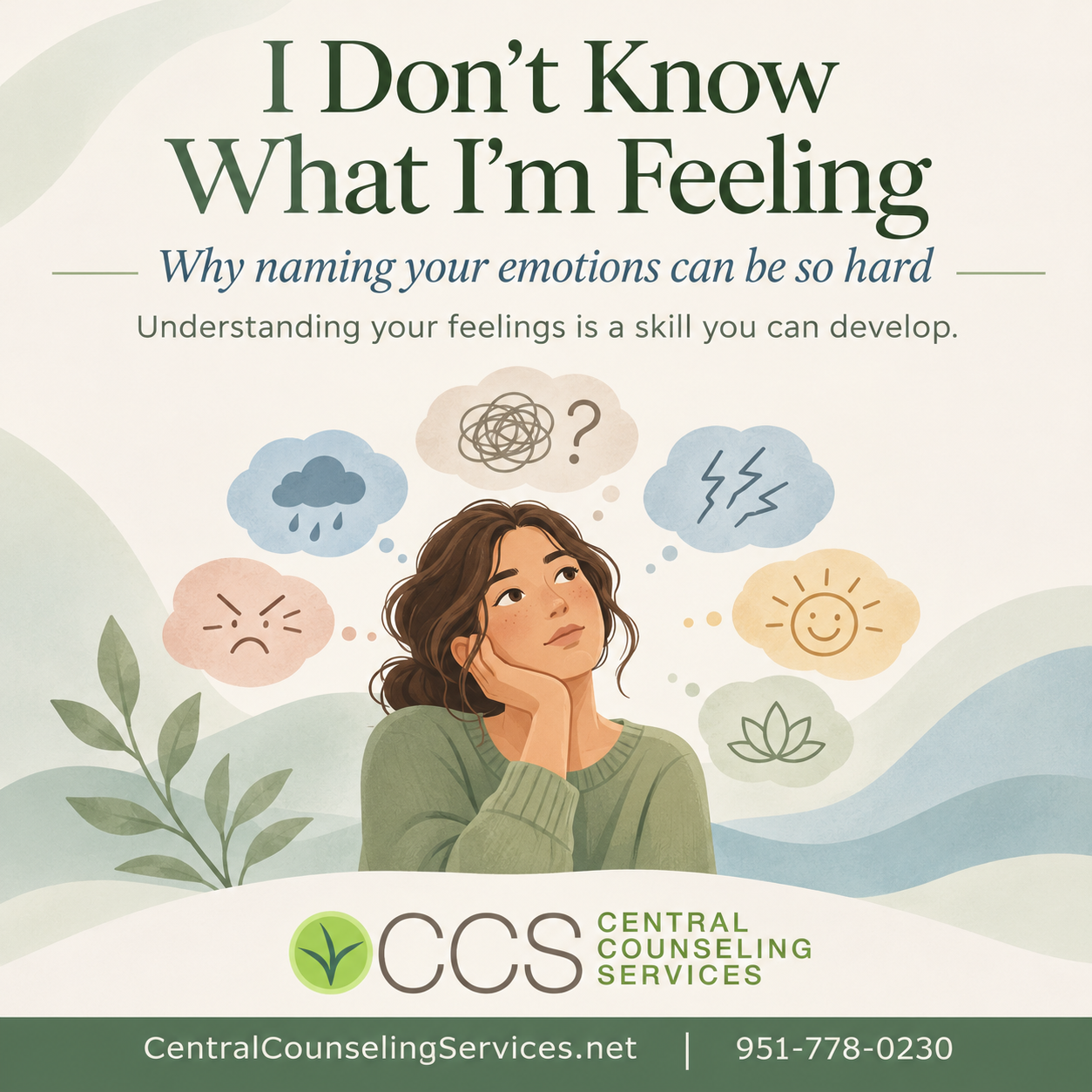
“Building emotional awareness doesn't require a complicated daily routine. A few small practices can help you become more familiar with your internal experiences.”
Understanding what you feel isn't always automatic. Emotional awareness is a skill, and like many skills, it can take practice, patience, and support.
Why Can It Be So Hard to Know What You're Feeling?
Emotions rarely arrive with clear labels.
You might experience tension in your shoulders, a racing mind, difficulty concentrating, or an urge to withdraw before you recognize what you're feeling emotionally.
Sometimes what seems like anger is also disappointment. What feels like anxiety may involve uncertainty or fear. What you describe as stress might include grief, frustration, loneliness, or several emotions at once.
Psychologists use the term emotional granularity to describe how precisely someone can recognize and distinguish between different emotional experiences.
For example, instead of simply saying, "I feel bad," someone might recognize, "I feel disappointed because I was looking forward to spending time together, and our plans changed."
That added understanding can create more opportunities to respond thoughtfully to what you need.
But developing this awareness isn't always easy.
When Stress Makes Emotional Awareness More Difficult
When life becomes demanding, recognizing your feelings may become less of a priority than simply getting through the day.
You're answering emails, getting the kids ready, meeting deadlines, managing responsibilities, and trying to keep everything moving.
Your attention is focused on what needs to happen next.
Sometimes, you don't realize how much you've been carrying until someone asks a simple question, an unexpected inconvenience occurs, or you finally have a quiet moment.
You might become irritated over something small, feel unexpectedly tearful, or want to be alone without understanding why.
These experiences don't necessarily mean you're overreacting. They may be signals that you need a moment to notice what's happening internally.
What We Learned About Emotions Growing Up
Our early experiences can influence how comfortable we feel recognizing and expressing emotions.
Some people grew up in environments where feelings were welcomed, discussed, and understood.
Others may have heard messages such as:
"Stop crying."
"You're being too sensitive."
"There's nothing to be upset about."
"Just get over it."
When emotions are repeatedly dismissed, some people learn to hide what they feel or question whether their emotional experiences are valid.
Others may have learned to pay close attention to everyone else's emotions while giving little attention to their own.
These patterns can continue into adulthood, sometimes making it difficult to identify personal needs, communicate during conflict, or recognize when something feels wrong.
The encouraging part is that emotional awareness can be developed throughout life.
Why Naming Your Emotions Matters
Putting your feelings into words is sometimes called affect labeling.
Research suggests that identifying and naming emotions may help people process emotional experiences and regulate their responses.
It doesn't mean that naming an emotion will immediately make it disappear.
Instead, recognizing what you're feeling may help you understand what is happening and consider what kind of response would be helpful.
For example:
If you're frustrated, you might need to address an ongoing problem.
If you're lonely, you might benefit from meaningful connection.
If you're disappointed, you might need time to acknowledge an unmet expectation.
If you're overwhelmed, you might need fewer demands or additional support.
And if you're feeling several things at once, you may need some time before deciding what to do.
You don't have to solve every emotion.
Sometimes, understanding it is a meaningful first step.
Five Ways to Start Understanding Your Feelings
Building emotional awareness doesn't require a complicated daily routine. A few small practices can help you become more familiar with your internal experiences.
1. Start With What You Notice in Your Body
Before trying to find the perfect word, notice what is happening physically.
Are your shoulders tense? Is your jaw clenched? Does your stomach feel unsettled? Are you unusually tired or restless?
Physical sensations don't always tell us exactly which emotion we're experiencing, but they can offer useful clues.
Try asking yourself, "What am I noticing right now?"
There's no need to force an answer.
2. Move Beyond "Good," "Bad," or "Stressed"
Broad emotional labels are a reasonable starting point, especially when you're tired or overwhelmed.
When you're ready, try becoming a little more specific.
Instead of "bad," you might explore whether you're feeling hurt, embarrassed, disappointed, lonely, or discouraged.
Instead of "stressed," you might notice that you're feeling pressured, worried, frustrated, or uncertain.
An emotion wheel or feelings list can be helpful when you're struggling to find the right words.
3. Allow More Than One Feeling at a Time
Emotions aren't always neat or mutually exclusive.
You might feel excited about a new opportunity and anxious about the changes it brings.
You might love your family and still feel frustrated by family responsibilities.
You might be proud of yourself while also feeling disappointed about something that didn't work out.
One emotion doesn't cancel out another.
Allowing mixed feelings can make it easier to understand the full picture of your experience.
4. Get Curious About What Your Emotion Might Be Telling You
Once you've identified a possible emotion, gently explore what may be connected to it.
Ask yourself:
What happened before I started feeling this way?
Is there something I need that I haven't acknowledged?
Am I reacting to the current situation, or does it remind me of something else?
What would support look like right now?
You may not find an answer immediately, and that's okay.
The goal is curiosity rather than judgment.
5. Practice Communicating Without Needing the Perfect Words
You don't have to fully understand an emotion before communicating with someone you trust.
You can say:
"I'm having a hard time explaining what I'm feeling."
"I think I'm overwhelmed, but I need a little time to understand why."
"I'm upset, and I'd like to talk when I've had a chance to think."
"I don't know exactly what I need yet."
These statements create room for honesty without requiring you to have everything figured out.
How Emotional Awareness Affects Relationships
When we struggle to recognize our feelings, communicating them to others can become difficult.
You might withdraw when you're hurt, become defensive when you're embarrassed, or express frustration when what you're really experiencing is disappointment.
A partner, friend, or family member may see the reaction without understanding the emotion underneath it.
This can create misunderstandings, especially when both people are trying to respond to emotions they haven't fully identified.
Learning to recognize feelings can support clearer communication, more thoughtful boundaries, and a better understanding of personal needs.
It can also make conversations less focused on blame and more focused on what each person is experiencing.
How Therapy Can Help
Therapy offers a supportive space to explore emotional experiences without the pressure of having all the answers.
A therapist can help you notice patterns, understand how stress and past experiences influence your responses, and develop ways to identify and communicate your feelings.
For some people, this work involves learning emotional vocabulary. For others, it may involve exploring anxiety, relationship patterns, trauma-related experiences, or long-standing beliefs about expressing emotions.
There isn't one correct way to experience or describe feelings.
Therapy can help you develop an approach that makes sense for your life and experiences.
You Don't Have to Have the Right Words to Begin
Sometimes the most important thing you can say is, "I don't know what I'm feeling, but I know something needs attention."
You don't have to understand every emotion immediately.
You don't have to explain yourself perfectly.
And you don't have to wait until you're completely overwhelmed to seek support.
Learning to understand yourself is an ongoing process, and you deserve patience and compassion along the way.
Central Counseling Services provides mental health support for individuals, couples, and families in Murrieta, Riverside, and surrounding communities, including the Temecula Valley.
To book an appointment give us a call at 951-778-0230 or To learn more about our services click here
Educational content only. This article is not therapy or a substitute for professional care.