
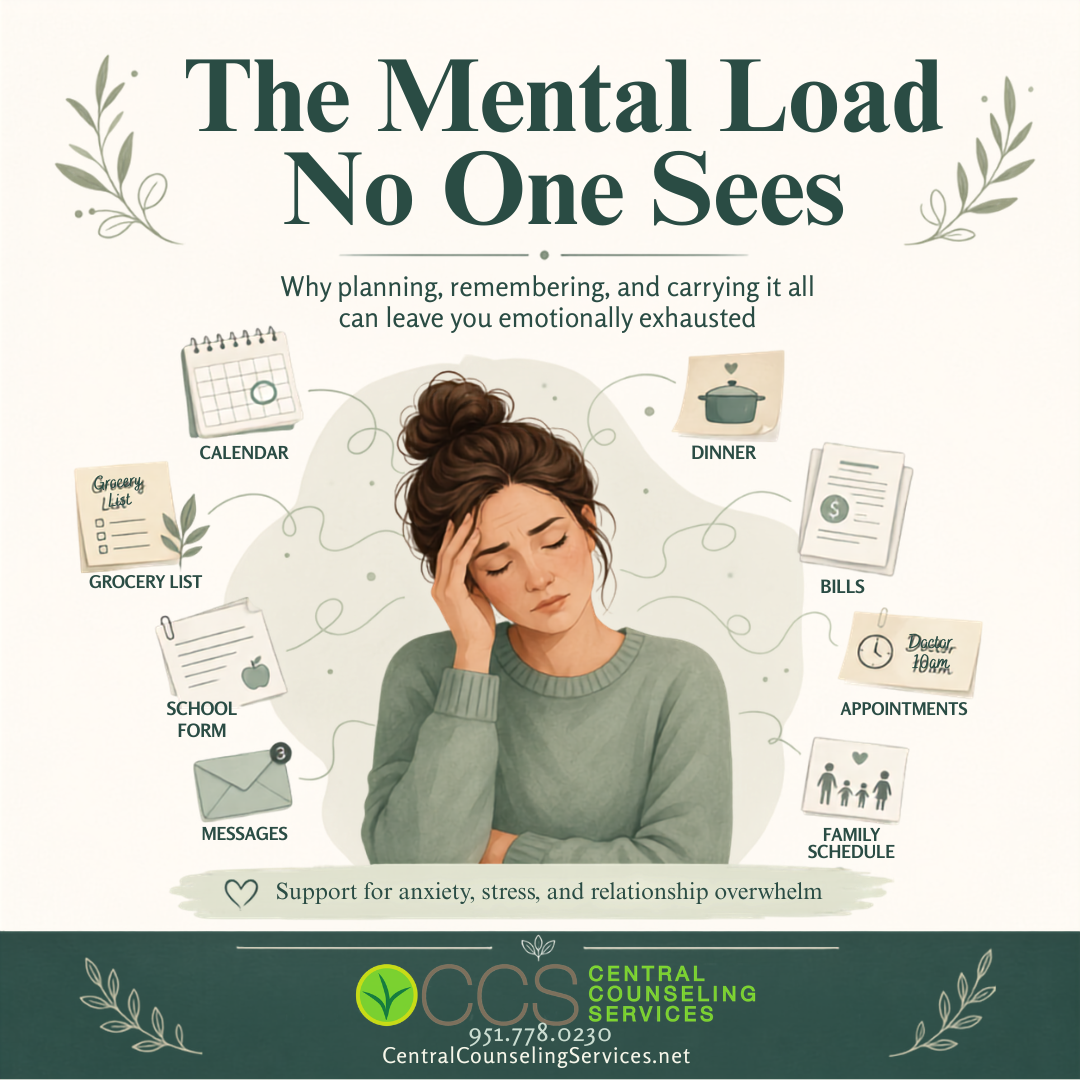
Some exhaustion does not come from what you physically did today.
It comes from everything you had to remember.
The appointment that needs to be scheduled.
The school form that has to be signed.
The groceries that are almost gone.
The birthday gift no one else thought about.
The bill that is due soon.
The text you still need to answer.
The emotional temperature of everyone in the house.
The question of what is for dinner, again.
This is often called the mental load.
The mental load is the invisible work of planning, remembering, anticipating, organizing, and managing life. It is not just doing tasks. It is being the person who notices what needs to be done in the first place.
And when one person carries too much of it for too long, it can affect mental health, relationships, and emotional well-being.
What Is the Mental Load?
The mental load is the behind-the-scenes responsibility of keeping life running.
It can include:
Remembering appointments
Tracking school, work, and family schedules
Managing household needs
Anticipating problems before they happen
Keeping track of everyone’s preferences
Planning meals, errands, events, and routines
Monitoring emotional needs in the family
Remembering birthdays, holidays, forms, bills, and deadlines
Knowing what needs to be bought, cleaned, fixed, packed, or handled
The mental load can be hard to explain because much of it happens internally.
From the outside, it may look like “nothing.” But inside, your brain may be running a constant background checklist.
This can leave people feeling exhausted before the day even begins.
Why the Mental Load Feels So Heavy
The mental load is not only about being busy.
It is about never fully being off-duty.
Even when you are sitting down, your mind may still be working. Even when you are resting, part of you may be scanning for what is next. Even when someone else helps, you may still be the one who had to ask, remind, explain, or delegate.
That kind of constant responsibility can create stress in the nervous system.
Over time, it may lead to:
Anxiety
Irritability
Burnout
Resentment
Sleep difficulty
Decision fatigue
Feeling emotionally drained
Trouble being present
Feeling unseen or unappreciated
It can also affect relationships, especially when one partner feels like they are carrying more of the invisible work and the other partner does not fully understand what is happening.
When “Just Ask for Help” Does Not Help
A common response to mental load stress is, “Just ask for help.”
But for many people, that does not solve the problem.
Because asking for help can become another task.
You may have to notice what needs to be done, explain it, remind someone, follow up, and then manage the emotional reaction if they feel criticized. This can make “help” feel less like shared responsibility and more like another form of management.
The issue is not always that no one helps.
Sometimes the issue is that one person is still carrying the responsibility of knowing, tracking, and directing everything.
That is why mental load conversations need to go deeper than task-sharing.
They need to include responsibility-sharing.
How the Mental Load Affects Relationships
When the mental load is uneven, resentment can build quietly.
One person may feel overwhelmed, unseen, or alone. The other may feel confused, criticized, or unsure why their efforts are not enough. Both people may become defensive.
The conversation may start with dishes, laundry, dinner, or schedules, but underneath it may be about something deeper:
“I feel like I am carrying this alone.”
“I want you to notice what needs to be done without me asking.”
“I am tired of being the manager of our life.”
“I want to feel like we are on the same team.”
“I do not want to resent you, but I am exhausted.”
When couples only argue about the task itself, they may miss the emotional need underneath it.
The task matters.
But the pattern matters too.
The Mental Load and Anxiety
For many people, the mental load is closely connected to anxiety.
If your brain is always tracking what could go wrong, what needs to happen next, and who might need something from you, your nervous system may stay on alert.
You may feel tense even when things are technically fine. You may have trouble relaxing because relaxing feels irresponsible. You may feel guilty when you rest because part of your mind is convinced something is being forgotten.
This can be especially common for parents, caregivers, working professionals, and people who learned early in life that staying prepared was a way to feel safe.
The mental load can become more than a household issue.
It can become a mental health issue.
You Are Not “Too Sensitive” for Feeling Resentful
Resentment is often treated like a bad emotion, but it can be useful information.
Resentment may be a signal that something feels unfair, unsustainable, or unspoken. It may be pointing to a need that has been ignored for too long.
Instead of shaming yourself for feeling resentful, try asking:
What am I carrying that others may not see?
Where do I need more shared responsibility?
What have I been afraid to say out loud?
What would support actually look like?
What would need to change for this to feel more balanced?
These questions can help shift the focus from blame to understanding.
What Can Help
Mental load stress does not usually improve through one conversation alone. It often requires ongoing honesty, communication, and new patterns.
Helpful steps may include:
Naming the invisible work clearly
Creating shared systems instead of relying on one person’s memory
Dividing responsibility, not just tasks
Having regular check-ins about household, parenting, or family needs
Reducing the number of decisions one person has to make alone
Practicing direct communication before resentment builds
Recognizing when anxiety or past experiences are intensifying the pressure
The goal is not perfection.
The goal is shared awareness, more honest communication, and a healthier balance of responsibility.
How Therapy Can Help
Therapy can help individuals, couples, and families understand how stress, anxiety, resentment, and communication patterns are affecting daily life.
Individual therapy can help you explore why it feels so hard to rest, ask for help, set boundaries, or stop over-functioning.
Couples therapy can help partners slow down the conflict and understand the pattern underneath the repeated arguments. Instead of focusing only on who did what, therapy can help couples talk about what each person is feeling, needing, and carrying.
Family therapy can also support healthier communication and shared responsibility, especially when stress has become the normal background of the household.
At Central Counseling Services, we support individuals, couples, and families navigating anxiety, relationship stress, parenting challenges, trauma, communication struggles, and emotional overwhelm.
You Do Not Have to Carry It All Alone
If you feel exhausted from managing everything, it does not mean you are failing.
It may mean too much has been living in your head for too long.
You deserve support.
You deserve rest.
You deserve relationships where your invisible work is seen and shared.
If you are in Murrieta, Temecula, Wildomar, Menifee, Riverside, or surrounding areas, support is available.
📞 Call us: 951-778-0230 or Click here to learn more.
Educational content only. This blog is not therapy or a substitute for professional care.