
When Work Stress Comes Home
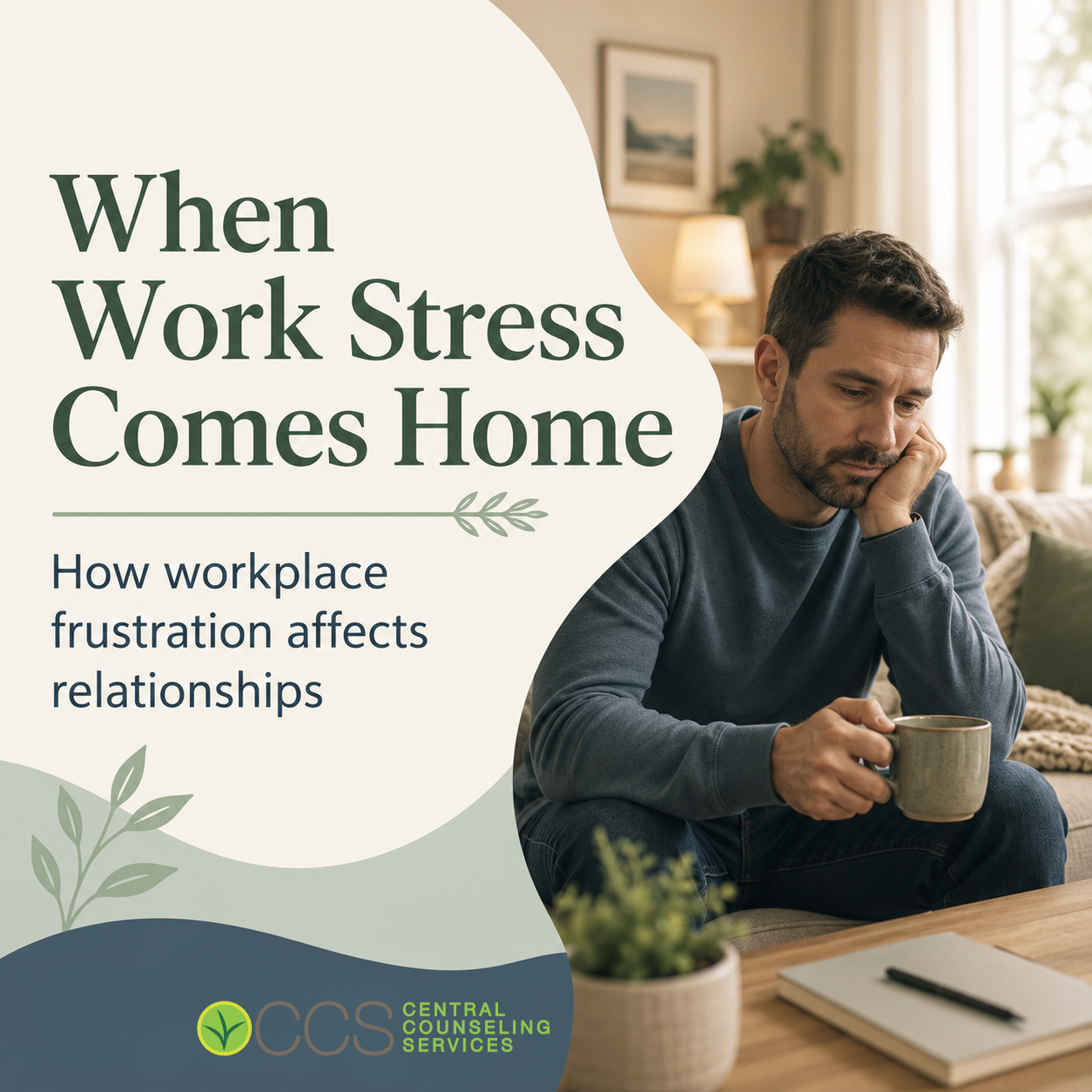
Work stress does not always stay at work.
Sometimes it follows you through the front door.
It shows up in the sharp tone you did not mean to use.
The silence at dinner.
The way one small question feels like too much.
The urge to scroll instead of talk.
The argument that started over dishes, laundry, homework, or what to eat for dinner, but was never really about any of those things.
For many working adults, parents, couples, and caregivers in Murrieta, Temecula, Wildomar, Menifee, Riverside, and surrounding communities, the workday does not end when the laptop closes or the shift is over.
The body may be home, but the nervous system is still at work.
Why Work Stress Follows You Home
When a day has been full of pressure, deadlines, difficult conversations, customer demands, workplace conflict, financial stress, or feeling underappreciated, your brain and body may remain on alert.
You may come home physically present but emotionally overloaded.
That can make ordinary home life feel harder than usual. A simple question like “What do you want for dinner?” may suddenly feel like one more demand. A partner asking for help may feel like criticism. A child needing attention may feel overwhelming. A small inconvenience may become the thing that finally pushes you over the edge.
This does not mean you are a bad partner, parent, friend, or family member.
It may mean you have been carrying more stress than people can see.
What Workplace Frustration Can Look Like at Home
Workplace stress can show up in relationships in subtle ways.
It may look like:
Snapping over small things
Feeling distant or emotionally unavailable
Withdrawing instead of talking
Feeling irritated when someone asks for help
Needing quiet but not knowing how to ask for it
Bringing work conversations into your head all night
Feeling resentful that everyone still needs something from you
Avoiding your partner because you do not have the energy to explain
Feeling guilty after reacting more strongly than you meant to
Over time, this can create a painful cycle.
One person comes home overwhelmed.
The other person feels shut out, ignored, or criticized.
Defensiveness builds.
Communication becomes shorter.
Both people feel alone.
The original stress may have started at work, but the relationship begins to carry its weight.
The Transition Home Matters
Many people move straight from work mode into home mode without any time to reset.
You may leave work and immediately enter traffic, errands, dinner, parenting, caregiving, household tasks, or relationship needs. There may be no real pause between “being productive” and “being emotionally available.”
But the nervous system often needs transition time.
Without a transition, stress can spill into the next part of the day.
A helpful question to ask is:
“What do I need before I can be present?”
Sometimes the answer is ten quiet minutes.
Sometimes it is changing clothes.
Sometimes it is taking a short walk.
Sometimes it is sitting in the car before going inside.
Sometimes it is saying, “I want to connect with you, but I need a few minutes to decompress first.”
Naming the need can prevent your loved ones from assuming your distance is rejection.
Stress Can Make Communication Harder
When stress is high, communication often becomes less clear.
You may become more reactive, less patient, or more likely to hear neutral comments as criticism. Your partner or family member may respond defensively, especially if they do not understand what is happening underneath your frustration.
A conversation that could have been simple can quickly become a conflict.
For example:
Your partner asks, “Did you remember to call them back?”
You hear, “You failed again.”
Your child asks for help with something small.
Your body hears, “There is one more thing I have to handle.”
Your partner says, “You seem distant.”
You hear, “You are not doing enough.”
Stress changes the way we interpret each other.
That is why slowing down matters.
How to Talk About Work Stress Without Dumping It on Your Partner
There is a difference between sharing stress and unloading it in a way that harms the relationship.
Sharing sounds like:
“I had a really hard day, and I think I’m carrying it home.”
“I’m feeling overstimulated and need a little quiet before I can talk.”
“I don’t want to take this out on you, but I’m struggling to shift out of work mode.”
“I need support, but I’m not sure what kind yet.”
Unloading may look like blaming, snapping, shutting down completely, or making the people at home responsible for fixing how you feel.
The goal is not to hide your stress.
The goal is to communicate it in a way that invites connection instead of creating more distance.
When It Becomes a Pattern
Everyone has hard days.
But if work stress is regularly creating conflict, emotional distance, resentment, or disconnection at home, it may be time to pay closer attention.
You may notice:
You dread going home even though you love your family
You feel constantly irritated or numb
Your partner says you are “never really here”
Arguments happen more often
You feel guilty for how you react
You are using distraction to avoid talking
You feel like there is no space where you can fully exhale
These patterns do not mean your relationship is failing.
They may mean the stress system needs support.
How Therapy Can Help
Therapy can help you understand how stress is affecting your emotions, communication, and relationships.
Individual therapy can support you in identifying stress patterns, building coping tools, setting boundaries around work, and learning how to regulate before stress spills over.
Couples therapy can help partners understand the cycle together. Instead of blaming each other, therapy can help both people ask, “What keeps happening between us, and how do we interrupt it?”
Therapy may support:
Healthier communication
Emotional regulation
Work-life boundaries
Stress management
Repair after conflict
Understanding relationship patterns
Reducing resentment
Creating more emotional safety at home
You do not have to wait until the relationship reaches a breaking point to ask for support.
A Small Practice for This Week
Before walking into your home, starting dinner, answering messages, or jumping into the next task, pause for one minute.
Ask yourself:
“What am I bringing home with me today?”
“What do I need before I respond to anyone?”
“How can I name that need instead of acting it out?”
Even a small pause can create space between stress and reaction.
That space matters.
Support Is Available
If workplace stress has been affecting your mood, communication, parenting, partnership, or ability to feel present at home, you are not alone.
At Central Counseling Services, we support individuals, couples, and families navigating anxiety, stress, trauma, relationship challenges, workplace overwhelm, and life transitions.
If you are in Murrieta, Temecula, Wildomar, Menifee, Riverside, or surrounding areas, our support is available.
Work may be stressful, but your relationships do not have to carry its full weight.
📞 Call us: 951-778-0230 or Click “Learn More” to get more information about us.
Educational content only. This blog is not therapy or a substitute for professional care.