Finding Your Center: Why Life Feels Harder in a World of “Easy Wins”
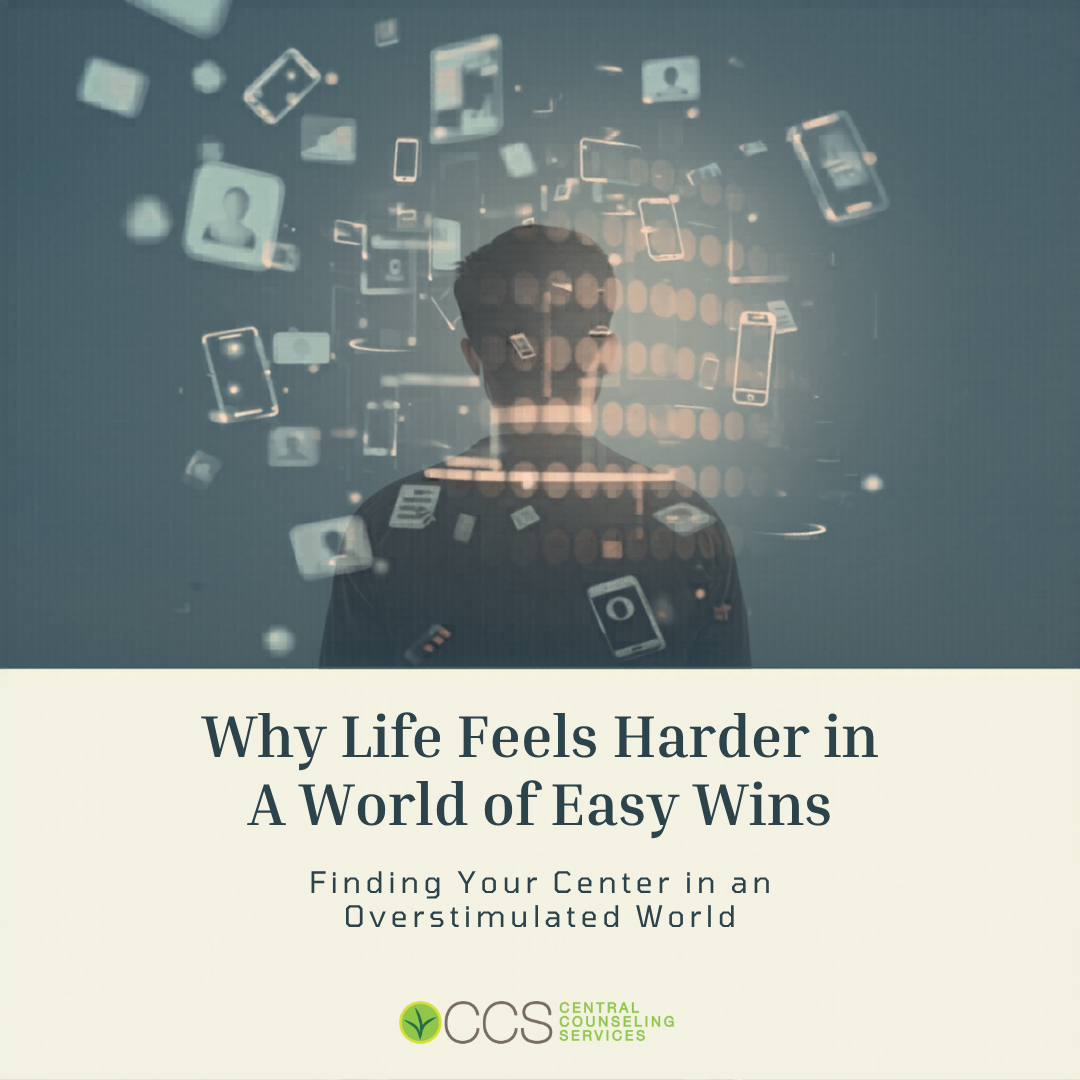
Ever feel like the more you scroll, snack, shop, or distract yourself, the more restless and emotionally drained you become?
You are not alone.
Many people today feel constantly overstimulated while simultaneously exhausted — plugged in all the time, yet somehow still running on empty.
According to Dr. Anna Lembke (2023), our brains are struggling to adapt to a world filled with constant “easy wins.”
Human beings evolved in environments where rewards were limited and effort was necessary. Today, dopamine — the brain chemical associated with motivation and reward — is available almost instantly through phones, social media, fast entertainment, processed food, online shopping, and endless notifications.
The result is not more happiness.
Often, it is more emotional exhaustion.
The Emotional Seesaw
Dr. Lembke describes the brain’s reward system like a seesaw. One side represents pleasure. The other represents pain.
When we experience something pleasurable, a social media notification, a sugary snack, a new purchase, the seesaw tips toward pleasure.
But the brain is constantly trying to maintain balance, a process called homeostasis.
To counteract pleasure, the brain pushes weight onto the opposite side: pain.
At first, this balancing process happens quietly in the background. But over time, with repeated overstimulation, those “pain weights” begin to linger.
That lingering imbalance can show up as:
Irritability
Restlessness
Difficulty concentrating
Low motivation
Emotional numbness
Anxiety
Feeling emotionally flat when stimulation stops
This is one reason ordinary tasks can begin feeling disproportionately difficult.
The “Easy Dopamine” Cycle
Modern life offers constant access to quick hits of stimulation.
Phones, streaming platforms, processed foods, shopping apps, gambling-style game mechanics, and social media algorithms are all designed to keep attention locked in and dopamine flowing.
Over time, the brain adapts.
Activities that once felt enjoyable may stop feeling satisfying. Instead of engaging in these habits because they feel genuinely rewarding, people often continue simply to avoid boredom, discomfort, or emotional emptiness.
The more the brain adjusts to constant stimulation, the harder it becomes to tolerate stillness.
Pleasure and Happiness Are Not the Same
One of the most important distinctions in this conversation is the difference between pleasure and happiness.
Pleasure tends to be:
immediate
intense
short-lived
dopamine-driven
often solitary
Happiness, however, is usually:
slower
steadier
rooted in connection
tied to meaning and contentment
A quick dopamine hit can feel good temporarily.
But lasting emotional well-being is often built through experiences that require patience, effort, connection, and presence.
Why Everything Starts Feeling Harder
When the brain becomes accustomed to constant stimulation, everyday responsibilities can begin feeling unusually exhausting.
Simple tasks like:
answering emails
paying bills
doing dishes
sitting quietly
reading
focusing
may suddenly feel overwhelming.
Not because you are lazy.
But because your nervous system has adapted to high levels of stimulation and now struggles with lower-dopamine activities.
How to Reset Your Nervous System
The good news is that the brain is adaptable.
Small changes can help restore balance over time.
Reduce “Easy Dopamine”
Taking intentional breaks from highly stimulating activities — such as social media, gaming, or excessive screen time — can help reset the brain’s reward system.
At first, this often feels uncomfortable.
That discomfort is part of the recalibration process.
Practice “Good” Discomfort
Certain forms of healthy discomfort can actually strengthen emotional resilience.
Examples include:
exercise
spending time outside
mindfulness practices
boredom without distraction
cold exposure
creative hobbies requiring focus
These experiences may feel effortful initially, but they often create more stable emotional regulation over time.
Create Boundaries Around Stimulation
Instead of relying on willpower alone, create environmental support.
Examples:
charging your phone outside the bedroom
turning off unnecessary notifications
limiting multitasking
setting screen-free times during the day
Small barriers create space for more intentional choices.
Prioritize Real Connection
The brain regulates best through meaningful human connection.
Long conversations, shared meals, laughter, movement, therapy, and emotionally safe relationships help support nervous system balance in ways endless scrolling never can.
You Are Not Broken
Many people blame themselves for struggling with focus, motivation, or emotional regulation in a world designed to constantly compete for attention.
But your brain is responding exactly as brains tend to respond to overstimulation.
Understanding this is not about shame.
It is about awareness.
And awareness creates room for change.
A Gentler Way Forward
You do not need to completely disconnect from modern life to feel better.
But slowing down, creating boundaries, and reconnecting with activities that create steadier forms of fulfillment can make a meaningful difference over time.
If you are feeling emotionally exhausted, overwhelmed, anxious, or stuck in cycles that feel difficult to break, support is available.
At Central Counseling Services, our therapists help individuals better understand their emotional patterns, nervous systems, and coping strategies in ways that support sustainable healing and growth.
📞 Call us: 951-778-0230
🌐 Visit: CentralCounselingServices.net
👤 ABOUT THE AUTHOR

Kayla Pronio, AMFT, APCC is an Associate Marriage and Family Therapist and Associate Professional Clinical Counselor at Central Counseling Services. She works with individuals, couples, families, and children across the developmental spectrum, with a focus on anxiety, depression, neurodiversity, and autism.
Kayla holds a Bachelor of Science in Psychological Sciences from the Honors College at the University of Arizona and a Master of Science in Counseling Psychology from California Baptist University. Her work integrates CBT, Solution-Focused Brief Therapy, mindfulness, and other evidence-based approaches to help clients build resilience and achieve meaningful goals.
REFERENCES
Huberman, A. (2025). Essentials: Understanding & treating addiction | Dr. Anna Lembke. Huberman Lab. Lembke, A. (2023). Dopamine and the pleasure–pain balance. Society for the Study of Addiction. Morales, I., & Berridge, K. C. (2020). “Liking” and “wanting” in eating and food reward: Brain mechanisms and clinical implications. Physiology & Behavior, 227, 113152. Wise, R. A., & Koob, G. F. (2014). The development and maintenance of drug addiction. Neuropsychopharmacology, 39(2), 254–262.